
Last spring I purchased NT Wright’s latest book and had the
great aspirations of reading it and reviewing it in 2012. I was able to do the
former in 2012, but barely. In fact, it was New Year’s Eve, sitting in the
Morgantown Starbucks that I was able to pour through the latter two thirds of
the book. In some ways, the reading and
review of this book typified 2012. There were goals that just got away from me
and so these goals need to be carried into the new year.
That being said, at last, I have been able to sit down and
write a brief review of Wright’s book. The book How God Became King: The Forgotten Story of the Gospels is a highly
accessible book for people who have committed their vocations to the teaching
of the Bible as well as to those who have committed their lives to being
ambassadors of the Kingdom of God.
The book is divided into four sections with the fourth being
a response to understanding Jesus birth, life, death, and resurrection as not
only in terms of atonement for sin, but as the beginnings of God putting all
things to right (including our own relationship with Him).
In the first section of the book, he deals with two extremes
that currently exist with regard to the life and teachings of Jesus. One is to
so fully focus on His divinity and His birth, death, and resurrection that one
misses His life. The other is to so focus on His life, that one misses the
meaning and significance of his birth, death, and resurrection. He also gives
some proposals as to how this split has happened as well as the incomplete
image both offer.
In the second section, Wright speaks of four areas of
emphasis within the gospels as four speakers in a sound system that need to be
brought into harmony. Two of the speakers are turned up really loud and play
distortedly, and in many ways drown out the remaining two speakers. Wright
proposes that what needs to happen for us to hear all of the fullness of the
message of the gospels is that we need to adjust the balance and volume of
these stories.
In the third section, he proposes what happens as the four
speakers are properly balanced. A story emerges that is the story of Israel
coming to it’s climax as well as the story of Israel’s God becoming king and
making his presence with humanity. In this story, everything doesn’t quite look
the way one would expect it to look, but part of the reason for this is the
linkage with the establishment of God’s Kingdom through suffering, service, and
taking up of one’s cross.
Wright further builds a case that in much of our modern
readings of the Gospels, we have uncoupled the Kingdom of God from being
anything of this world or having any place in this world, and as a result we
miss some of the very real and tangible opportunities for learning not only
from the life of Jesus, but also seeking to live life as ambassadors of the
Kingdom of God in the here and now.
Unfortunately a review this brief simply does not do the
book justice, so rather than try to write lots more, I will simply encourage
you to purchase a copy and give it a read, along with Wright’s other writings.
And regardless of whether you read the book or not, I invite
you to take a moment, and reflect on what life might look like in your
neighborhood, in your job, and in this world, if God’s rule was reflected
there? And what might it look like for you to be an ambassador of what it would
look like?
Just a little food for thought for 2013.


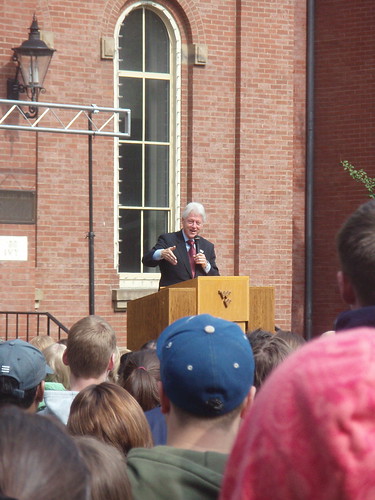









Last Thursday, the 42nd President of the United States, < href="http://www.whitehouse.gov/history/presidents/bc42.html">William Jefferson Clinton, came to visit Morgantown and West Virginia University. He was traveling to campaign for his wife Hillary's bid for the Democratic nomination for President this year.
Initially, I was just going to stop by and snap a few photos, and be on my way, but I stuck around. (He was running late, and I had already waited an hour, so I thought, "what's a few more minutes?) As he stood before a crowd of students and community members, I could see that he was a very charismatic and sanguine individual. He won the crowd almost immediately by commenting on the quality of WVU football, and how much he enjoyed watching them play this year.
Part of the reason I wanted to stop by was simply the thought that it isn't often that one gets to listen directly to one of the most powerful leaders in contemporary history. The President of the United States is perhaps the most powerful leadership position on the planet. And I was standing about 100 feet from a former president--pretty wild stuff.
As he spoke, I couldn't help but analyze what he had to say. It wasn't the policies themselves that I was tuned into, it was the style of speaking he used. After all, anybody who is attempting to vote responsibly should probably take the time to read up on the issues, policies, and perspectives of all candidates beforehand. Seem's like every candidate for public office throughout history offers a similar case. First they remind individuals of how bad things are currently, and prognosticate an even worse future. Then they say that the way to rescue yourself from that terrible future is to take the action step of voting them (or their spouse or their candidate of choice) into office.
As I listened to the former President speak, I found myself thinking about the hope that every candidate attempts to offer, and how there is really only One who can offer us hope, security, prosperity, and peace.
I believe voting is an important privilege and responsibility for American citizens, and particularly for Christians. But as Christians, we can't just vote for a party, we have to examine all of the issues. We understand that there will never be a true savior on capital hill until Jesus comes back (as the Derek Webb song reminds us).
In this season, when so many are attempting to offer us a temporal peace and prosperity, let's take time to remember the One who offers true hope and peace to our whole world.