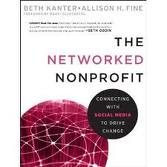
Sometimes I’m an early adopter, and sometimes I move a bit more slowly. When Beth Kanter and Alice Fine’s book came out last summer, I moved a bit more slowly than most to purchase a copy and begin reading. I’ve moved even more slowly when it has come to writing a review.
I bought my copy last October in an effort to better articulate my own experience with social media, while at the same time leaning on the learnings of others in the sector. What I like best about the book is that it starts with a very basic approach that helps to build credibility for social media as a tool for driving change, and then continues to give a variety of tools, approaches, and information, to help users of social media to make the most of their online efforts.
Of particular interest to me was the chapter devoted to a describing how social media enables to engage with others on an unprecedented scale. From blogs to twitter, to facebook, we are able to connect with people in a way that has not been as readily available to past generations.
Beth Kanter and Allison Fine lay out a number of too.s and means for engagement from the highly technical (like social media mapping) to the highly relational and empowering (like crowdsourcing).
The authors, although highly capabale in the academic arena, write this book as practitioners to fellow practitioners. In terms of being ‘peer-reviewed’ work, the authors have attracted the eyes and attention of many in the non-profit and social media sectors.
I had the privilege of meeting Beth Kanter last spring while attending a conference called the !deation as a representative of Nuru. She was every bit as congenial, friendly, and encouraging in person as she is online, or in her books.
One aspect of social media that receives a lot of buzz, but I didn’t see a ton of information addressing in the book was the realm of analytics and metrics. Perhaps it is because if one is engaged in a relationship with folks who are friends, fans, or followers of a non-profit, then there is less need to track how the relationships form. I know that in my personal life, I don’t apply analytics to determine how I make friends, I just meet people from a wide array of backgrounds, and I find myself wanting to become friends with them as I get to know them.
If you are in the non-profit world, and you use social media, I would highly recommend The Networked Nonprofit. It isn’t a long book, and it is chock full of information regardless of your level of involvement in the realm of social media. (And you can read it in one sitting~but you will probably want to re-read!)


As a result, I realized that on average, I probably would have spent about $3/day on beverages. A cup of coffee here, and a soda there, and some juice at this spot all kind of add up. Of course there were days when I probably wouldn't have bought anything, but I think I realized over the course of time that I take for granted that I have all of these choices.
In the end, the amount I donated was a combination of what I would have spent combined with the amount I actually did spend on occasion (there were a few times I downed a coke, a coffee, or a vitamin water), and a little bit on top just to round everything out.
It's been an eye opening time with regard to the access to a variety of beverages and even more so to the availability of clean drinking water at my disposal.
If you get a chance, check out this website, and perhaps take stock of the simple pleasures like water that we all take for granted.
And, if you are so inclined, I encourage you to give to Nuru as well. It's a great organization, and they are planning to drill four deep water wells during the month of May for the 5000 people of Kuria, Kenya.
Will you join me in helping to bring lasting change to the people of Kuria?